Disclaimer: This post contains affiliate links. As an Amazon Associate, I earn from qualifying purchases at no extra cost to you. [Learn More]
Tiny details are part of what makes miniature painting so rewarding. Whether it’s the expression on a face, the reflection in a gemstone, or a carefully placed edge highlight, those little finishing touches are often what transform a good miniature into one you’re proud to display or put on the gaming table.
For years, I never gave magnification much thought. If I needed to see something a little closer, I’d simply lean in. As I’ve gotten older, however, I realized the problem wasn’t my painting – it was my eyesight. Today I wear multifocal contact lenses, which are wonderful for everyday life but make focusing on tiny details surprisingly difficult. That’s when I discovered magnification, and it completely changed the way I paint.
For me, magnification isn’t about painting better. It’s about painting comfortably and continuing to enjoy the hobby.
Before investing in magnification, it’s worth making sure your workspace is properly illuminated. Good lighting alone often makes fine details much easier to see.
➡️ Choosing the Best Lighting for Miniature Painting
The Day I Learned Why Magnification Matters
Years ago, while working at the Warhammer store, a gentleman walked in carrying his miniature collection. He wasn’t there to show it off – he had decided to give it away because, as he explained, his eyesight had deteriorated to the point where he could no longer paint. Per his request, I helped find homes for many of the models (and they were incredibly grateful), and several remained in the store’s display cabinets for quite some time.
I still think about that conversation. At the time, I didn’t know much about magnifying lamps or hobby visors, but looking back, I often wonder whether introducing him to one of those tools might have allowed him to continue enjoying the hobby he clearly loved. Maybe it would have helped, maybe it wouldn’t – but it taught me something important: sometimes we don’t leave the hobby because we’ve lost interest. Sometimes we leave because a problem seems impossible to solve.
I felt there was more to his reasoning, but I guess the reason he gave has to be enough. I sensed sorrow in him giving up his collection and tried to comfort him as much as I could. Like surrendering a beloved pet, I assured him his models would go to proper homes where they would be loved, and they did.
Fortunately, today there are more options than ever to help painters continue enjoying miniature painting, regardless of age or eyesight.
Do You Actually Need a Magnifier?
Not necessarily.
If your close-up vision is still good, a quality daylight task light may be all you ever need. Many painters produce incredible work without using magnification at all.
However, if you find yourself leaning closer and closer to the miniature, struggling to paint tiny details, or ending every painting session with tired eyes, magnification can make an enormous difference. It doesn’t improve your brush control or magically make you a better painter—it simply lets you see your work more clearly.
A Magnifying Lamp (My Personal Setup)
This is the setup I personally use and recommend for painters who need magnification regularly.
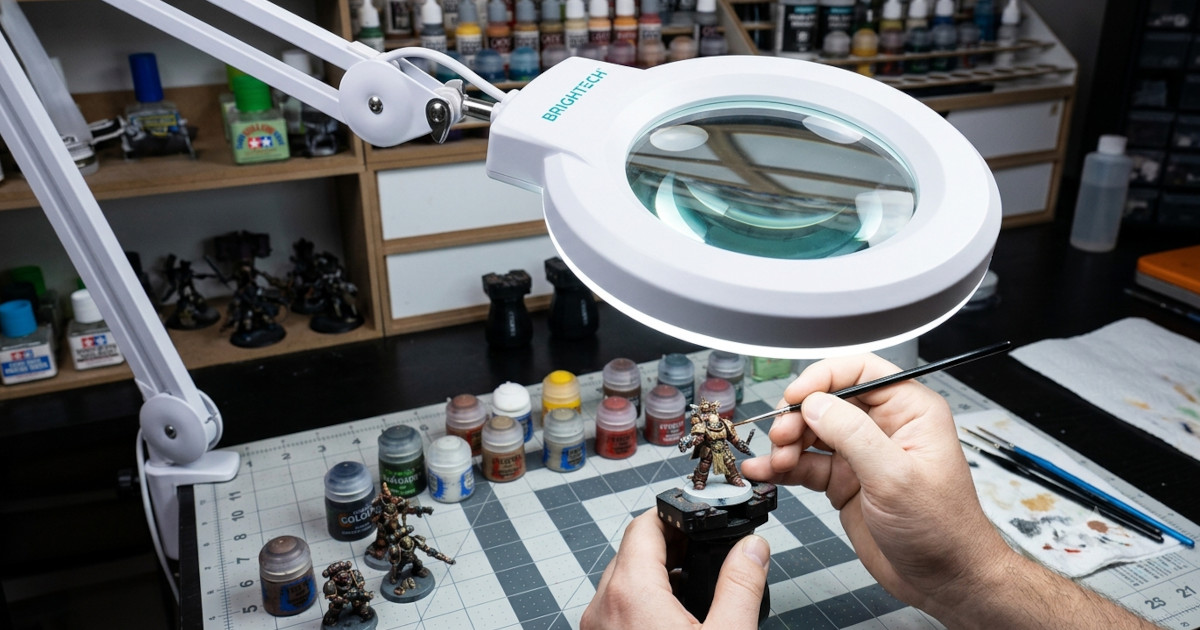
The Brightech LightView Pro combines a bright, daylight-balanced LED light with a large glass magnifier, giving me excellent illumination and crystal-clear close-up vision in a single tool. I keep the weighted base toward the back of my painting station so it stays completely out of the way, while the flexible gooseneck allows me to position both the light and magnifier exactly where I need them.
Because I rely on magnification every time I paint, having both functions built into one setup makes perfect sense. It keeps my workspace simple and lets me focus entirely on the miniature. Honestly, I would truly struggle to paint without it.

- Two in One, Magnifying Floor Lamp with Flexible Gooseneck for Hands-Free Close Work The flexible gooseneck on this magnifying floor lamp adjusts to direct the light and lens where you need it, and the head stays in place during use. It includes a 1.75X magnification glass lens and 10 dimmable light color options for different tasks. This 2 in 1 design can function as a floor lamp or table lamp by inserting or removing the included pole.
- 20 Years Life LED Lights For Max Durability – 4.5″ diameter lens magnifies tasks 1.75 times while eliminating eyestrain. You can also adjust the color level anywhere in-between 4,000K – 6,000K. The brightness level can be adjusted via the dim control feature. The LED lights are built-in and are rated to last up to 20,000 hours – about 20 years if you use this magnifying floor lamp for 3 hours every single day!
- Magnifying Floor Lamp to Assist with Macular Degeneration & Aging Eyes: Multiple testimonials from those with macular degeneration and from aging customers show that older eyes need extra light & magnification, to see details and contrast. From reading the fine print on pill bottles to seeing individual threads in a sewing project, small color nuances in a puzzle or fiddly jewelry clasps, countless activities require light and magnification. Our magnifying floor lamp provides this and more.
- A Thoughtful Present for Every Stage of Life: Searching for a remarkable gift? Look no further! Our magnifier lights are the ideal gift for students, mothers, fathers, partners, spouses, children, kids, or parents for Back to School, Off to College, Graduation, Christmas, Birthday, Winter Holiday, Mother’s Day, Father’s Day, Wedding, Anniversary and Business Achievement
- The Warranty: Our floor and table lamps are built to last, and we stand behind that. That’s why Brightech USA offers an industry-leading 3-year warranty covering defects, malfunctions, or sudden failures to your table lamp when purchased through us. Thanks to our friendly USA-based support team, you’ll rest easy knowing your desk lamp has the backing you can trust.

Desktop Magnifiers
If you only need magnification occasionally, a simple desktop magnifier can be an excellent compromise.
Used alongside a quality task light, these magnifiers can be moved into position whenever you’re painting particularly fine details, then easily set aside for the rest of your session. They’re also an affordable way to see whether magnification improves your painting experience before investing in a dedicated magnifying lamp.
I ran with one of these for a couple of years before upgrading to the Brightech. It worked great – magnifying parts of the model I needed to see with more detail, and it gave me plenty of clearance to work with brushes or tools in my hands.
Desktop magnifiers need somewhere stable to mount.
➡️ Choosing the Right Desk or Table for Miniature Painting

- Fully Adjustable Hand-Held or Hands Free Magnifier Lamp with Scratch Resistant Large Acrylic Lens ; Compact and Lightweight ; Perfect Low Vision Aide
- 2x Power Magnification with 3.5x Power Spots Lens ; LED Lighted with 2 Built in Super Bright LED Bulbs ; Powered by 2 AA Batteries (Not Included)
- Magnifying Lamp is Great for Reading Fine Print, Labels, Books, Magazines, Coupons, Model Building, Hobbies, Arts, Crafts, Soldering and Needlework ; Use The Spot Lens for Close Detail Inspection of Coins, Stamps, Insects, Wildlife, Small Electronics and
- The Flexible Arm allows you to adjust the magnifying glass lens where you need it most
- Lens Diameter: 4.25 inches
Head-Mounted Magnifiers
Not everyone wants a magnifying lamp sitting beside their painting desk, and that’s perfectly understandable.
Head-mounted magnifiers are lightweight, affordable, and don’t take up any workspace at all. Most include several interchangeable lenses, allowing you to choose the magnification that works best for different painting tasks.
They’re an excellent option if you already have good task lighting, paint in multiple locations, or simply prefer the freedom of moving your head instead of repositioning a lamp. Several people used these while hanging out and painting at the Warhammer store.
The OptiVisor with the 2.5X mag provides an 8′ focal length. This hits a sweet spot for miniature painting because it’s close enough to see fine details, but far enough away that you still have room for:
- your brush,
- your hands,
- rotating the miniature,
- working comfortably without feeling cramped.
The goal isn’t simply seeing tiny details more clearly. It’s removing another obstacle that keeps you from enjoying the hobby.
➡️ Building an Efficient Painting Workflow Station
Most painters can paint an entire session wearing this comfortably. If you increase Mag (like 2.75X) then you reduce focal length. If you increase focal length (say 10″) then you reduce the amount of Mag (2x). So, the 2.5X is ideal.

- Binocular headband magnifier provides hands-free magnification and viewing for a variety of applications such as jewelry-making, watch-making, needlework, artwork, electronic inspection, book-reading, print inspection, and stamp-collecting
- Available in multiple dioptric strengths (indicated by the model number) that provide a specific magnification power (X), depending on the distance from the object
- A dioptric number and a magnification number are not the same thing. Diopter strength represents a specific magnification power (X). For example, a 5-diopter provides 2.5X magnification (at a distance of 8”)
- Optical glass lenses are ground and polished into prismatic lenses for quality and clarity
- Can be worn over prescription or safety eyeglasses
Magnification Doesn’t Make You a Better Painter
Using magnification isn’t “cheating.” Having an awesome painted collection isn’t a competition.
Magnifiers don’t paint smoother blends. They don’t improve your brush control, teach color theory, or magically fix mistakes. They simply remove one unnecessary obstacle by letting you see your work more clearly.
In many ways, they’re no different than using good lighting or a comfortable chair. They’re tools that help you spend less energy fighting your workspace and more energy enjoying the creative process.
If all else fails, see your local Painboy about fitting a cybork eye. Results may vary, but it certainly earns hobby points and getting to better brushin.
Final Thoughts
One lesson I’ve learned over the years is that we often wait until something becomes a problem before looking for a solution.
If you’re constantly leaning closer to your miniature or ending painting sessions with tired eyes, you don’t have to accept that as part of getting older. Whether that’s a magnifying lamp, a head-mounted visor, or a simple desktop magnifier, the right tool can make painting more comfortable than ever.
Miniature painting should be relaxing. It should be creative. It should be something you look forward to after a long day.
Sometimes the right tool doesn’t make you a better painter.
Sometimes it simply helps you keep painting.
Continue Your Painting Journey
Choosing the Best Lighting for Miniature Painting
Lighting and magnification work hand in hand. Learn how proper illumination reduces eye strain and helps you paint fine details with greater confidence.
How to Create the Perfect Miniature Painting Space
A magnifier is just one part of a comfortable hobby desk. See how your chair, desk, lighting, and organization all contribute to a workspace you’ll enjoy using for years.