Disclaimer: This post contains affiliate links. As an Amazon Associate, I earn from qualifying purchases at no extra cost to you. [Learn More]
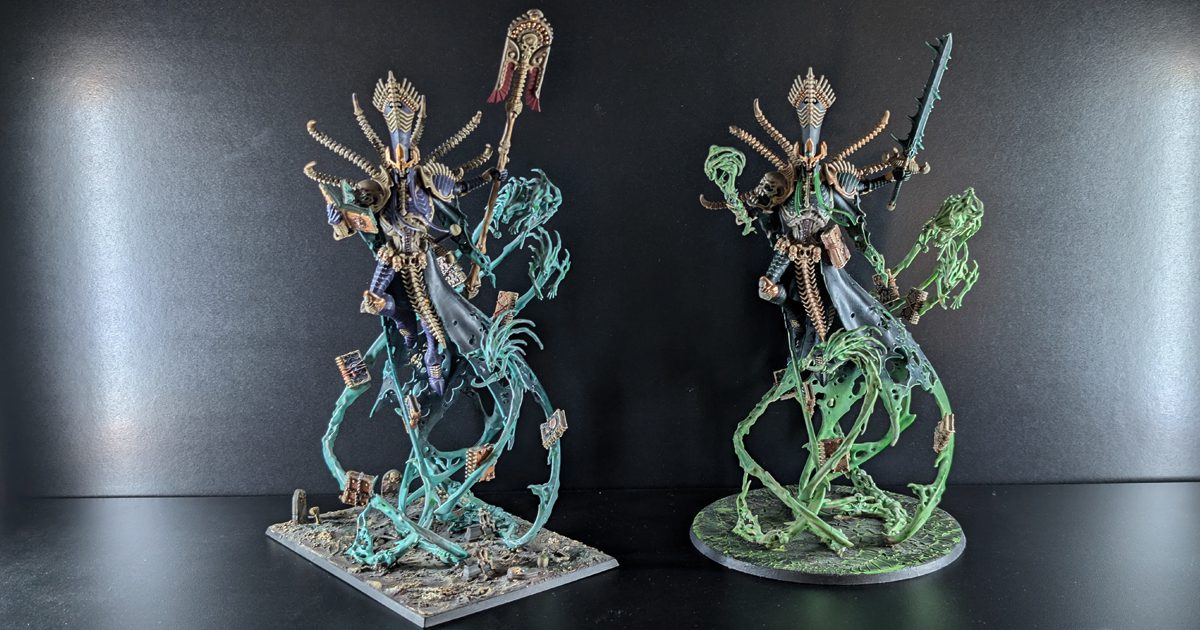
There are two Nagash models currently in my display case. They were painted a couple of years apart. They weren’t built the same way – in fact, they’re nearly opposite builds of the same model. They weren’t painted for the same reason, but they exist for the same reason.
The First Nagash
The first Nagash wasn’t something I chose. He was a gift, given to me by the person I still think of as my Jedi Master in the hobby. At the time, I didn’t fully understand the motive behind the gesture – I only knew that I had to make it awesome.
At the same time, a large event was coming together at the local shop, where he was the manager. A 20-foot gaming table with dozens of players – something closer to a battle royale than a standard game. It was certainly promotional, but it was also an opportunity for the hobby community to celebrate each other’s work and roll some dice. The kind of event where stories are told for years afterward, legends.
Nagash was going to lead my army. He had to be finished – and not just finished, but done in a way that would be imposing and menacing on that table. And he was.
Around that same time, it was announced that Tomb Kings (Bretonnia also, but they’re not relevant to the story) – were being discontinued. Tomb Kings were where I started; they were my way into the hobby. I soon found kits were becoming harder to find due to the FOMO crowd and those who would capitalize in after-market. There was also an uncertainty of their role in the future of the game.
I had already begun moving into Vampire Counts as my faction. A chapter was ending, but a new adventure was becoming transformative, and that sense of transition found its way into the Nagash model that I worked.
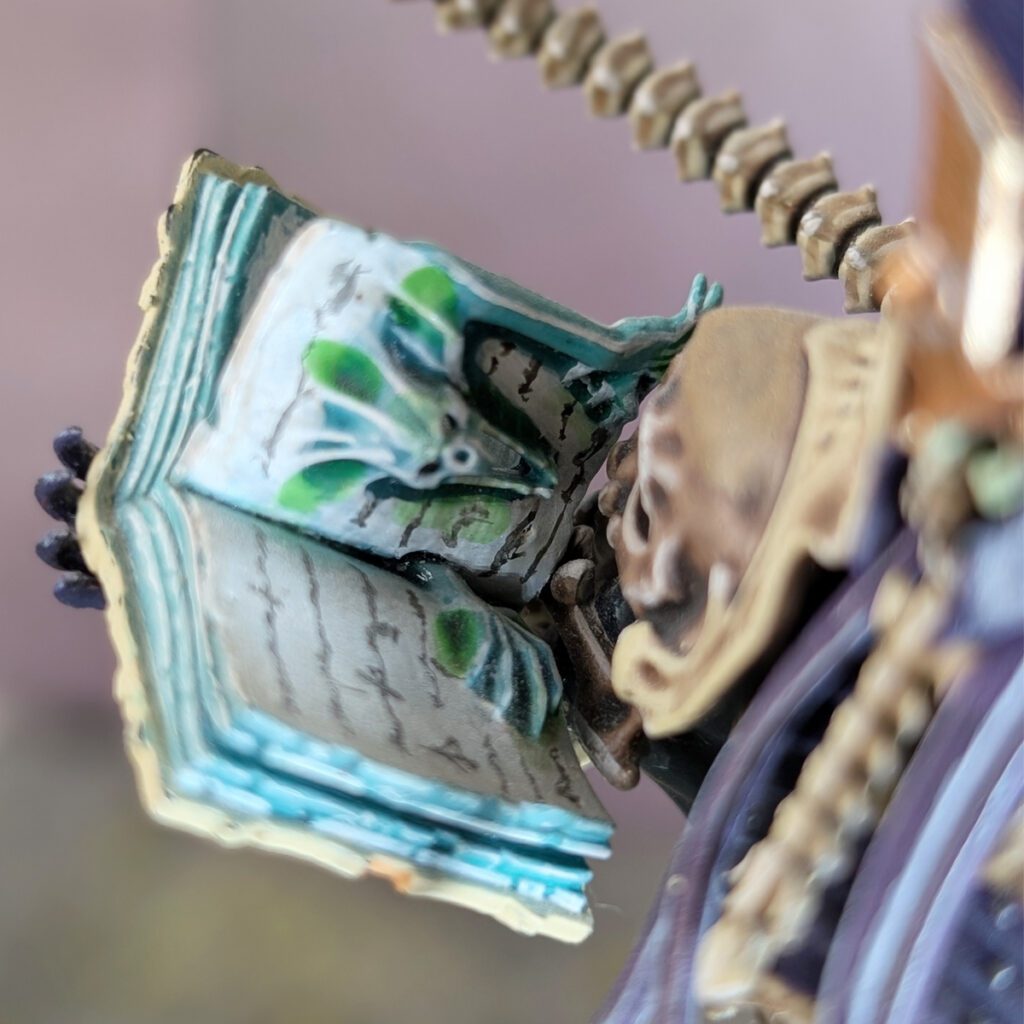
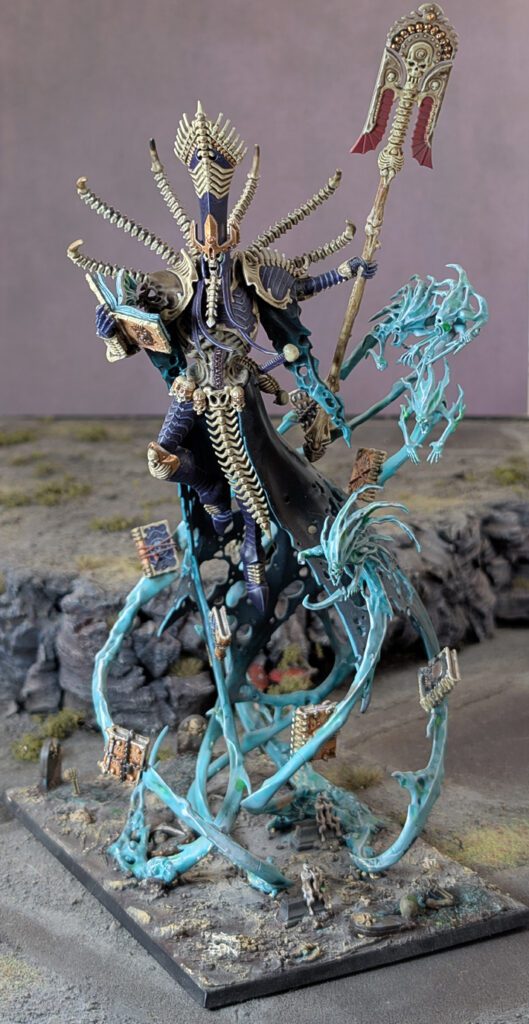
I painted Nagash as the legendary necromancer and god of death that he is – staff in hand, one of the Nine Books open, a spirit pulling free from its pages. I followed a tutorial from Duncan Rhodes for most parts of the process; I had never attempted a model of this magnitude, complete with separately painted subassemblies. Ultimately, the brushstrokes and craft were my own.
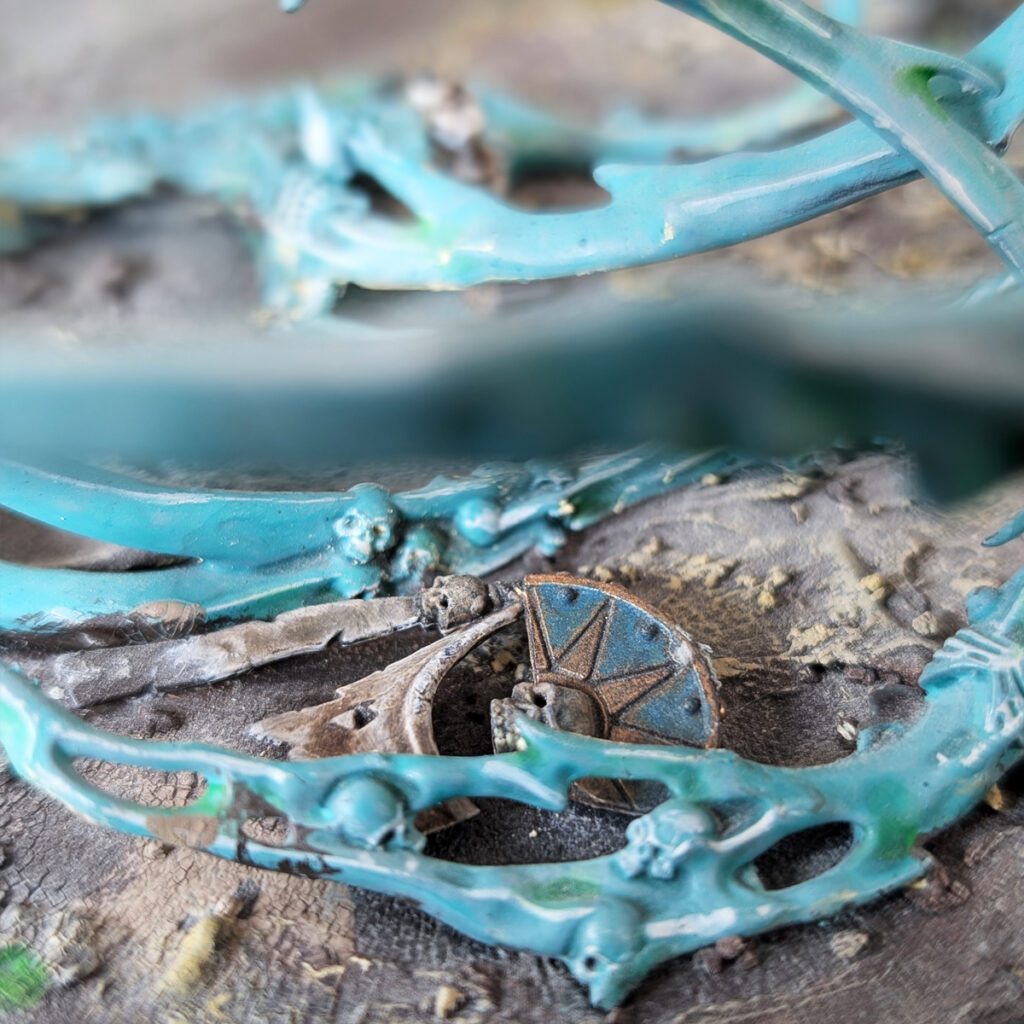
The base especially became an expression of that transition.
Scattered across it were the remnants of Tomb Kings – banners, shields, fragments of an army that had only briefly been mine. A couple of skeletons clawed their way up from the ground, caught somewhere between what was and what was coming next.
The basing wasn’t planned. The decisions came as I worked, one after another, without much deliberation. By the time it was finished, it was clear what it had become: a sendoff to my Tomb Kings. It was also a beginning – the unholy reign of Nagash and his legions of skeletons, spirits, ghouls and vampires had commenced.
The Second Nagash
The second Nagash started differently.
It was a commission from a friend at the Warhammer store, Josh, who asked if I would paint his, knowing that I was capable. We had spent a lot of time around the same tables, along with a friend-group that blurred the line between gaming and just spending time together. Some of those connections have lasted. One of them went on to found Rocky Top Game Con. The hobby has that way about it – people and events, threads that come back around to you.
At first, I thought this commission would be straightforward. I had already painted Nagash once. I knew the process. I could follow the same steps and arrive at something similar.
But Josh had a different vision.
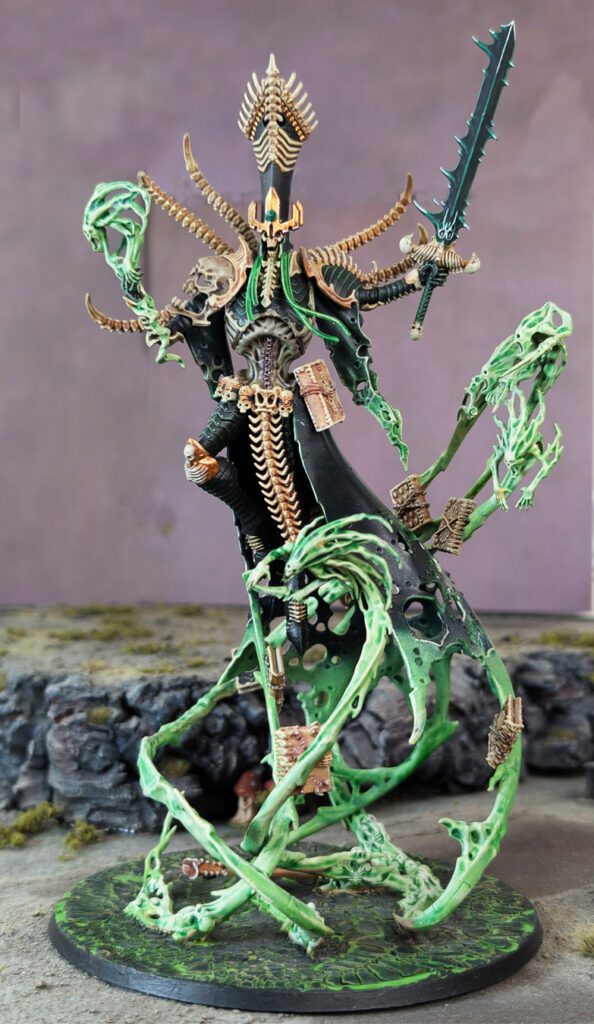
The staff was replaced with a sword. The spellbook was gone. In its place, a spirit pulled itself into existence from Nagash’s outstretched hand. The silhouette changed. The story changed. The color scheme changed with it – black armor with sharp green highlights, reminiscent of the fel-green glow from World of Warcraft: The Burning Crusade.
It wasn’t subtle. It wasn’t familiar territory, and it wasn’t my idea. I also knew from prior experience that black is an unforgiving color to work with.
Around that same time, Josh was planning a trip to the Warhammer Citadel in Grapevine, Texas. My old mentor – the one who gave me my first Nagash – had moved on to become the first general manager there.
The project started connecting threads I hadn’t expected.
Josh wanted to bring his army with him. He wanted the Nagash model to be part of that, and I knew how important that was for him because of my own experience with the first Nagash. While he was there, he picked up a limited-edition portrait of Nagash. The pose and color within the portrait aligned almost perfectly with what he had asked for in a paint job from me. It was only in hindsight that I recognized the full extent of his inspiration, and I was honored to have brought something close to that vision into physical form.
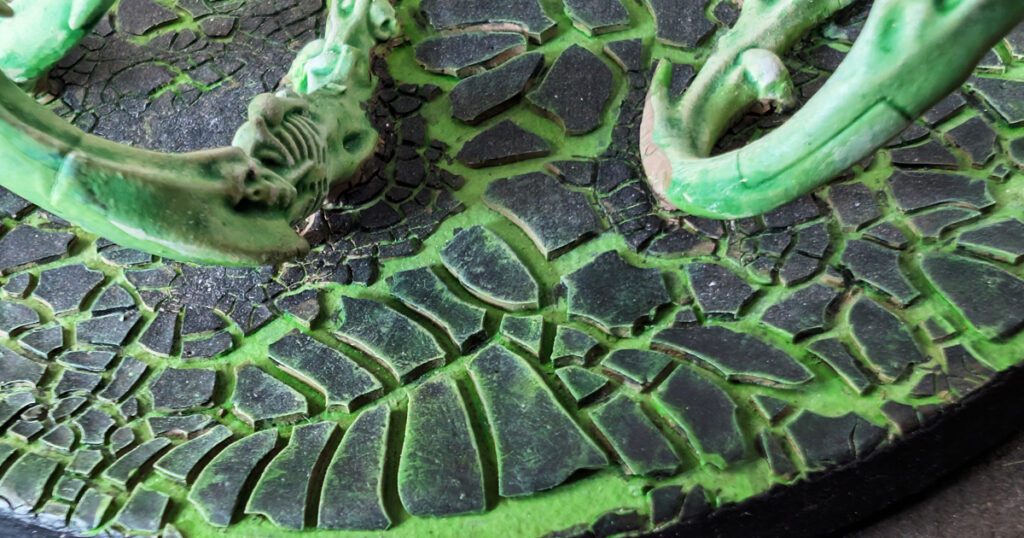
The base became the place where I pushed further.
A full coat of green went down first, followed by a thick layer of crackle paint. As it dried, it split apart – pulling back into islands and exposing the green underneath. Not subtle cracks, but wide breaks, as though something beneath the surface was forcing its way through.
Each segment was painted back in black to match the armor, leaving the green glowing between them. It looked less like ground and more like something unstable and unnatural – the kind of terrain you’d expect in Shyish, the Realm of Death.
By the time it was finished, it didn’t feel like a repeat of the first Nagash. It couldn’t have been. Too many of the decisions had come from someone else’s vision. And somehow, fulfilling that vision made it just as personal. Years later, Josh stepped away from the hobby and gave much of his collection to friends. It felt fitting that Nagash – among other models – found his way back home.
What Drives the Work
The two models don’t share much on the surface. They are different builds, different color schemes, and came from entirely different starting points. But they were both carried by something stronger than motivation.
The first was driven by meaning:
- A gift
- A deadline
- A transition from one army to another
The second was driven by direction:
- A client’s vision
- Constraints
- A clear picture of what the finished piece needed to be
Different forces, same result. Both were finished. Both were pushed further than needed because of the personal level of importance each one portrayed.
The Creator Mindset
Most painters wait for motivation, as though it exists somewhere outside of them – something that arrives, takes hold, and allows them to begin. There is also that early surge, the excitement of starting something new. But that isn’t what carries a project to completion.
What actually drives the work is something more grounded:
- A reason that matters
- A direction that limits your choices (Keep It Simple, Space King)
- A sense that the piece needs to exist for a purpose, not just be started and tossed aside
Sometimes that reason, direction, or sense comes from within. Sometimes it is handed to you outside of your comfort zone. Either way, it changes how you work. You stop asking whether you feel like painting, and instead your time begins to organize itself around the painting desk.
Two Models
There are two Nagashes in my display case. One marked the end of one chapter and the beginning of another. The other followed a path that didn’t start as my own, but I ended up fostering. Neither is more important than the other, and each of them is loved for different reasons. The first came at a crucial point in my development and proved what I was capable of. The second exists because I wanted to explore what else was possible – and because someone else’s vision gave me the opportunity to do so.
On the surface, the difference between them is in the paint. At a deeper level, it’s in the reasons they were painted – the inspiration, the motivation, the direction, and the creative outcomes that followed.
More than anything, these are the motives that satiate an artist, a creator.